
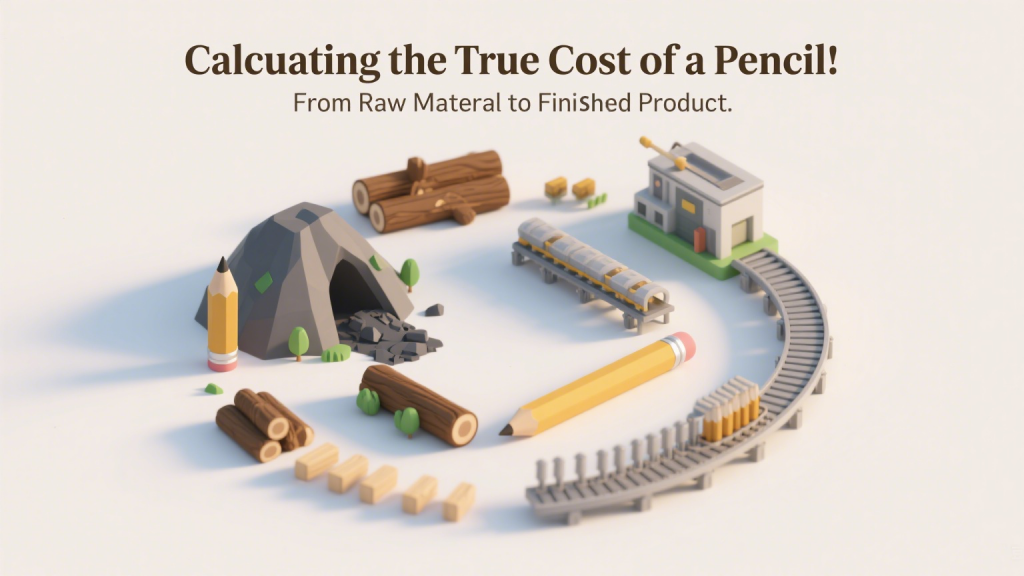
The humble pencil, a symbol of simplicity and creativity, is anything but simple to produce. Its cost is a story of global supply chains, precision engineering, and razor-thin margins. For buyers, understanding this cost structure is power—the power to negotiate better, spot quality issues, and make smarter sourcing decisions.
Here’s a detailed breakdown of the costs behind a standard HB #2 wooden pencil, sourced from Yiwu and produced at a mid-size factory.
1. Raw Material Costs (The “Bill of Materials”)
This is the physical cost of the components that make up the pencil.
| Component | Cost (per pencil) | Details & Sourcing Notes |
|---|---|---|
| Graphite-Clay Core (Lead) | ¥0.008 – ¥0.012 | Cost varies by graphite purity (Sri Lankan vs. Chinese) and mixing formula. HB #2 is the cheapest blend. |
| Wood Casing (Cedar or Basswood) | ¥0.018 – ¥0.025 | Basswood is standard in China. Cedar is a premium upgrade. Wood accounts for ~40% of material cost. |
| Ferrule (Aluminum) | ¥0.005 – ¥0.008 | The metal band that holds the eraser. Aluminum is standard; brass is a premium, corrosion-resistant option. |
| Eraser (Synthetic Rubber) | ¥0.006 – ¥0.010 | Cheap pink erasers are PVC-free synthetic rubber. Higher-quality latex erasers cost 50-100% more. |
| Paint & Finish | ¥0.003 – ¥0.005 | Multiple coats for opacity and branding. Metallic or specialty paints increase cost. |
| Glue | ¥0.001 – ¥0.002 | Used to secure the ferrule and seal the wood slats. |
| **Total Material Cost | ~¥0.041 – ¥0.062 | ($0.0056 – $0.0085 USD) |
2. Manufacturing & Labor Costs
This is the cost of transforming raw materials into a finished product.
| Cost Factor | Cost (per pencil) | Details & Sourcing Notes |
|---|---|---|
| Labor | ¥0.01 – ¥0.015 | Highly automated lines require few workers for operation and QC. Labor is a smaller factor than many assume. |
| Machine Depreciation | ¥0.005 – ¥0.01 | Pencil-making machines (slat, assembly, painting) are expensive. Cost is amortized over millions of units. |
| Factory Overhead (electricity, rent) | ¥0.005 – ¥0.008 | Energy costs for drying ovens and powering machinery. |
| Quality Control | ¥0.002 – ¥0.004 | Sorting warped pencils, checking eraser attachment, testing lead breakage. |
| **Total Production Cost | ~¥0.022 – ¥0.037 | ($0.003 – $0.0051 USD) |
3. The Hidden Costs: Compliance, Packaging & Profit
This is where many buyers get surprised. The pencil itself is only part of the equation.
| Cost Factor | Cost (per pencil) | Details & Sourcing Notes |
|---|---|---|
| Packaging | ¥0.01 – ¥0.03 | A major cost driver. A simple poly sleeve is cheap. A blister card or gift box can cost more than the pencil. |
| Certification | ¥0.002 – ¥0.005 | Non-negotiable for export. Costs for CE, UKCA, ASTM F963 (Toy Safety), CPSIA, EN71 tests are spread across units. |
| Supplier Profit Margin | ¥0.01 – ¥0.03 | A factory’s typical margin is 10-15%. Higher for complex orders, lower for massive bulk. |
| **Total Hidden Costs | ~¥0.022 – ¥0.065 | ($0.003 – $0.009 USD) |
The Total Cost: Bringing It All Together
FOB Yiwu Cost per Pencil (Standard HB #2, Unsharpened, Bulk Packed):
- Low-End: ¥0.041 (Materials) + ¥0.022 (Production) + ¥0.022 (Hidden) = ¥0.085 / pencil
- High-End: ¥0.062 (Materials) + ¥0.037 (Production) + ¥0.065 (Hidden) = ¥0.164 / pencil
This translates to a FOB cost of approximately $0.012 – $0.023 USD per pencil.
What Drives the Final Price for Buyers?
Your final cost per pencil is determined by three key factors:
- Order Quantity (MOQ): This is the biggest lever.
- < 5,000 units: You’ll pay a premium for a “sample run” – ~$0.07 – $0.12/unit.
- ~50,000 units: Standard MOQ tier – ~$0.02 – $0.04/unit.
- > 500,000 units: You are setting the price – ~$0.011 – $0.015/unit.
- Customization: Any change from the standard recipe adds cost.
- Custom Logo Print: +¥0.02 – ¥0.05/unit (setup fee + ink)
- Unique Color/Paint: +¥0.01 – ¥0.03/unit
- Special Shape (e.g., Hexagonal): +¥0.005 – ¥0.015/unit (slower production)
- Eco-Friendly (e.g., Recycled Paper Barrel): +15-30%
- Quality Tier:
- Economy: Uses lower-grade graphite (grittier), softer wood, minimal QC. Prone to breakage.
- Premium: Uses polymer-infused graphite (smoother), stronger cedar wood, stringent QC. Costs 2-3x the economy price.
The Buyer’s Cheat Sheet: Questions to Ask Your Supplier
To understand what you’re really paying for, ask these questions:
- “What is the graphite origin and purity grade?” (Ask for data sheet)
- “What type of wood do you use? Is it seasoned?” (Basswood is standard, cedar is premium)
- “Can you provide the break-strength test results for the lead?” (A sign of good QC)
- “Are the certifications (ASTM, EN71) included in this price, or are they extra?”
- “What is the exact MOQ breakpoint for a lower price?”
Your Next Step in Yiwu Sourcing:
Understanding the true cost empowers you to negotiate on specs, not just price. At Penink Stationery, we provide full transparency into the cost structure of your order, ensuring you get the quality you pay for.
👉 Take Action Today:
- Request a Cost-Breakdown Analysis: www.peninkstationery.com
- Direct Sourcing Support: WhatsApp +86 139 5844 9443
We turn complex supply chains into clear, cost-effective advantages.